
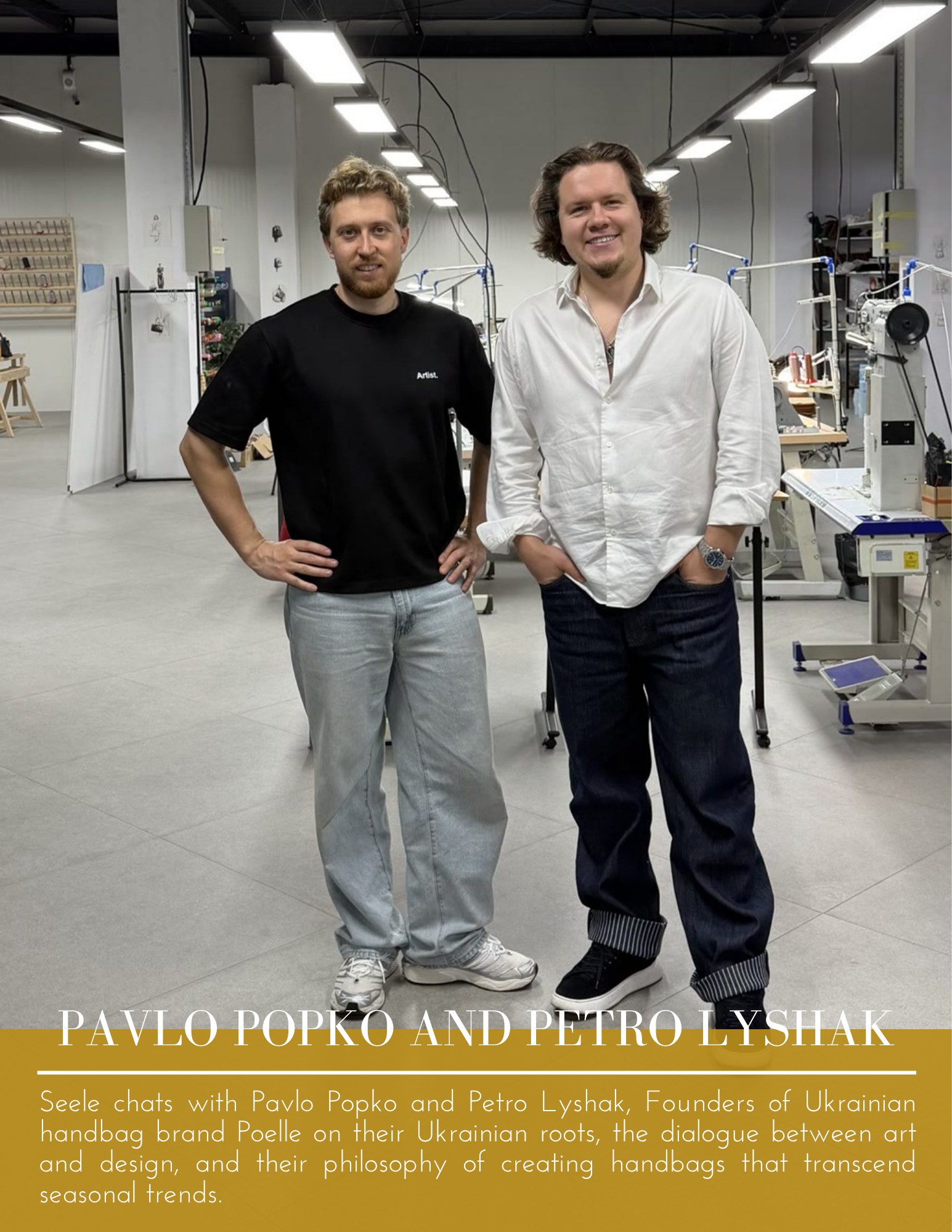
While we are interested in their products, which are phenomenally crafted, we are also interested in why they believe a handbag should exist in a woman’s life. This Q&A is not just a product profile but also a story about two founders redefining what a handbag can mean: not simply an accessory to wear, but an object of art, craftsmanship, and personal expression that grows more meaningful with time.
This feature has been created around three central themes:
Art as the starting point: How Pavlo and Petro transform artistic ideas into sculptural, distinctive handbags.
Luxury as longevity: Why quality, thoughtful design, and enduring relevance matter more than seasonal desirability.
Identity without excess: The philosophy of designing handbags that reveal a woman's individuality rather than compete with it.
Two Founders, One Vision
Seele Magazine: You found the brand together in a small town in Ukraine’s Lviv region. What brought the two of you together creatively, and what was the original idea or conviction that made you believe there was room for a different kind of handbag brand?
Pavlo: It started with my grandmother's old Italian bag that I found in the attic. I took it apart and made a knife sheath, and a wallet from the leftovers. By 2017 I was selling men's leather goods on Etsy. The idea of a real brand came in 2021, when Petro and I were walking through the Dubai Mall and saw an empty unit between Chanel and Hermès.
Petro: I came from IT, not fashion, and in 2022 I offered to help Pavlo sort out the processes. Two months later we were partners. Pavlo sees the object; I see the system around it. We both believed there was room for a brand with its own atelier, where form matters more than the logo.
Building Something Beyond Trends
SM: Fashion is constantly moving toward the next big thing. What inspired you to build a brand around longevity instead—and what does creating a handbag that outlasts the season mean to you in practical and philosophical terms?
Petro: We make every bag in our own atelier in Horodok, about fifty people. When you see how many hours go into one piece, it feels wrong to design it for one season. In practical terms, longevity means a structure that keeps its shape, edges that don't crack, a lining that doesn't wear through, and a one-year warranty we actually honor. Philosophically, it means we would rather a woman buy one Poelle bag and carry it for years than buy three bags she forgets by spring.
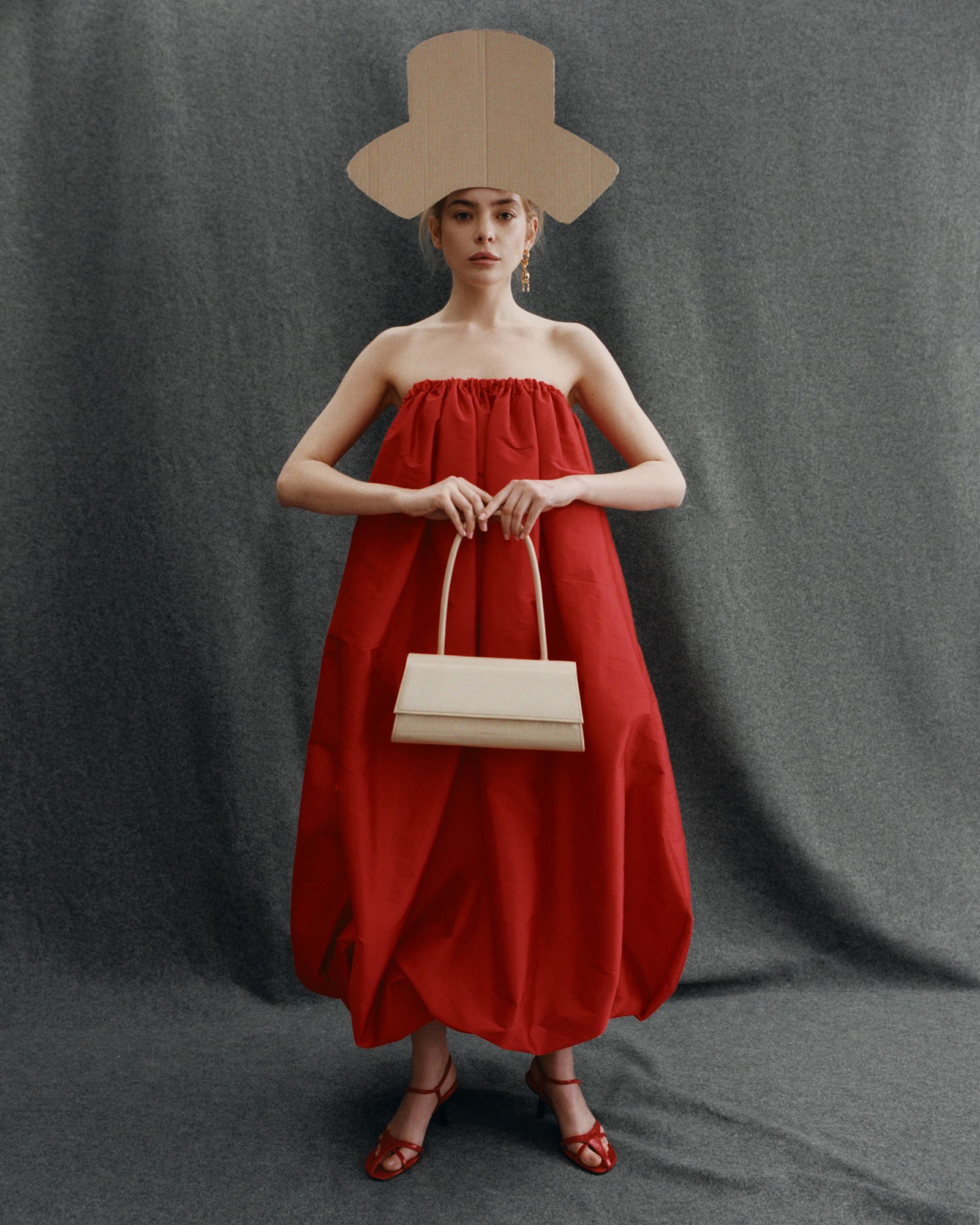
The Milky Untitled handbag, $420 | Photo provided by Poélle
A Dialogue With Art
SM: You describe each collection as beginning with a dialogue with art. Where does that conversation begin? Is it a particular artist, a work of art, an emotion, or an idea—and how does that initial spark ultimately become a tangible handbag?
Pavlo: It usually starts with a feeling, then I find the art that holds it. Color Field came from Rothko and Malevych: big, quiet planes of color. Stilleven came from Dutch still-life painting, the beauty of ordinary objects. Papier Collé came from the collages of Picasso, Braque and Matisse. From there we go to sketches, paper patterns and the first leather prototype. Then stylists and friends of the brand carry the samples in their everyday life before anything goes into production.
The Beauty of an Unconventional Shape
SM: Your handbags are distinguished by their unique silhouettes. How do you approach shape and proportion differently from brands that follow familiar handbag conventions? What allows you to recognize when a design feels genuinely new yet remains timeless?
Pavlo: My favorite line is Saint-Exupéry's: perfection is reached not when there is nothing left to add, but when there is nothing left to take away. I look at Bauhaus architecture and at Malevych more than at other handbags. A new shape has to have one clear idea. The Riposo shopper, for example, is shaped like a sea wave, from a childhood memory of a trip to the sea with my mother. If a shape still makes sense after we remove every unnecessary detail, I know it can last.
The Woman Behind the Design
SM: Your motto is to create pieces that never overshadow a woman, but reveal her. What does that philosophy tell us about the woman you design for, and how do you translate her individuality, confidence, and personal style into the objects you create?
Pavlo: She doesn't need a bag to tell the room who she is. She has her own taste, her own work, her own rhythm. Our motto is "Belong to yourself. Inspire others." So, the bag has to be calm enough to fit her life, from a laptop and a coat in the morning to dinner in the evening, and interesting enough that she notices it every time she picks it up. Many of our models are named after women who inspire us. Josefine, for example, is named after Joséphine Bonaparte.
Quiet Confidence in a Loud Fashion World
SM: In an industry often driven by visible logos, status symbols, and spectacle, your approach suggests a more understated kind of luxury. How do you define quiet confidence, and can a handbag make a powerful statement without demanding attention?
Petro: Quiet confidence is when you don't need to explain yourself. A bag can make a statement through its shape, its proportions and the quality of the leather in your hand, not through its size or a big logo. The women who buy Poelle often tell us the same thing: people stop them to ask what the bag is. That is the kind of attention we like. It starts a conversation instead of showing a price tag.
The Craft Behind the Object
SM: Leather and suede are materials with distinct textures, personalities, and aging processes. What draws you to them, and how do you balance their natural character with the precision, durability, and distinctive shapes your designs require?
Pavlo: Leather and suede are alive. Smooth leather keeps a clean line and gets a soft glow with time; suede is warm, deep in colour and asks a little more care. Our shapes are structured, so the challenge is to keep that natural softness while the bag still holds its form for years. That balance happens in the atelier: the right thickness for each part, hidden reinforcement where the structure needs it, and hand finishing on the edges.

The Object №03 handbag starts at $520 and ranges to $680 | Photo provided by Poélle
Designing From Lviv, Thinking Globally
SM: Your atelier is based in a small town in Ukraine’s Lviv region. How does working there shape your creative process, your relationship with craftsmanship, and the identity of the brand? What can emerge from a place outside the traditional fashion capitals that might not emerge elsewhere?
Petro: Horodok is a small town near Lviv, and our atelier is a real workshop, not a studio far from the production floor. Pavlo can walk from a sketch to the cutting table in a minute, and the craftspeople see the whole bag, not one step of it. Being outside the fashion capitals also means we don't copy what we see on the street around us. We bring Ukrainian craft and our own view of art, and now we ship to the US, the UK and Europe from that same small town.
The Meaning of Making in Ukraine
SM: Building a premium fashion brand in Ukraine carries a particular context, especially amid the country's recent history and ongoing challenges. How has your experience as Ukrainian founders shaped your understanding of resilience, creativity, and the responsibility of building something meant to last?
Petro: We built the women's line during the full-scale war. Our atelier keeps working through air-raid alerts and power cuts, and our team keeps its promises to customers anyway. That teaches you what resilience really is: not a big gesture, but showing up every day and doing the work well. For us, building something meant to last is also a way to show the world Ukraine as a country of modern design, not only of headlines.
The Partnership Behind the Product
SM: As two founders, you bring two perspectives to a single creative vision. Where do your instincts naturally align, and where do they clash? Can you recall a disagreement that ultimately made a design—or the brand itself—stronger?
Petro: We align on quality. Neither of us will release a bag we wouldn't give to our own mothers. We clash on pace: I want to scale, Pavlo wants one more prototype.
Pavlo: Our biggest lesson was the men's line. We started there because the numbers said men bought more on Instagram, but it never felt like the full brand. When we moved to women's bags in 2024 with L'Art de Vivre, everything changed. That turn made Poelle what it is today.
What Makes a Handbag Worth Keeping?
SM: When you imagine one of your bags being carried for ten or fifteen years, what do you hope it will have come to represent for its owner? Beyond material quality, what makes an object worthy of being kept, lived with, and passed down?
Pavlo: I hope that after ten years the bag becomes part of her story: the trips, the first day at a new job, the dinner she remembers. Good leather takes those years beautifully. An object is worth keeping when it was made with care, when it works every day, and when it still feels like you. If one day she gives it to her daughter and says "this was mine", we did our job.
The Legacy You Want to Leave
SM: If the brand succeeds in changing the way women think about the handbags they buy and keep, what would you want that change to be? And years from now, what would make you feel that you had built something meaningful beyond a successful fashion label?
Petro: I'd like women to buy fewer bags and choose them better: to ask who made it, where, and how long it will last. And I'd like people to hear "Ukrainian design" and think of form, craft and taste. If in ten years our atelier in Horodok still trains young craftspeople and our bags are carried in cities around the world, that will mean more to us than any label.
TRENDING

Seele chats with Pavlo Popko and Petro Lyshak, Founders of Ukrainian handbag brand Poelle on their Ukrainian roots, the dialogue between art and design, and their philosophy of creating handbags that transcend seasonal trends…