
Most Common Secondhand Scams - 63 Cases Analyzed
1 in 3 people buying secondhand online end up scammed, according to a Which? UK Consumer Survey. Almost a third of those scams start the same way: the seller asks to move the conversation off the app. "Can we talk on WhatsApp?" showed up in 29% of the cases we analyzed.
Key Findings:
· Most common trick affecting buyers is a fabric swap, when the knit looks thick in the photo, but is thin polyester in the parcel.
· The biggest single tell is any push off the app, to WhatsApp, CashApp or a lookalike site.
· Two-thirds of scams happen on resale apps, but the other third are fake dropshipping shops made to look secondhand.
Red flag phrases, ranked by how often they appeared:
1. Offering to take it off the app (29% of cases)
The biggest red flag is a seller moving you off the app. Once you're on WhatsApp or paying by CashApp, the platform can't protect you.
Watch for: "Can we talk on WhatsApp?", "Pay via CashApp to save on fees", "I overpaid, refund the difference?", "Upgrade to a business account", "Click here to release your funds." A real seller never needs you to leave the app.
2. Faking the quality in photos (22% of cases)
The red flag that affects buyers hardest is a listing that lies about quality, like a thick knit in the photo that arrives as thin polyester. The apps rarely refund this, because it counts as disappointment, not fraud.
Watch for: "sold as new" on items with only flattering, far-away photos. Before you pay, ask for close-ups in natural light of any wear, the label and the seams. A real seller will send them.
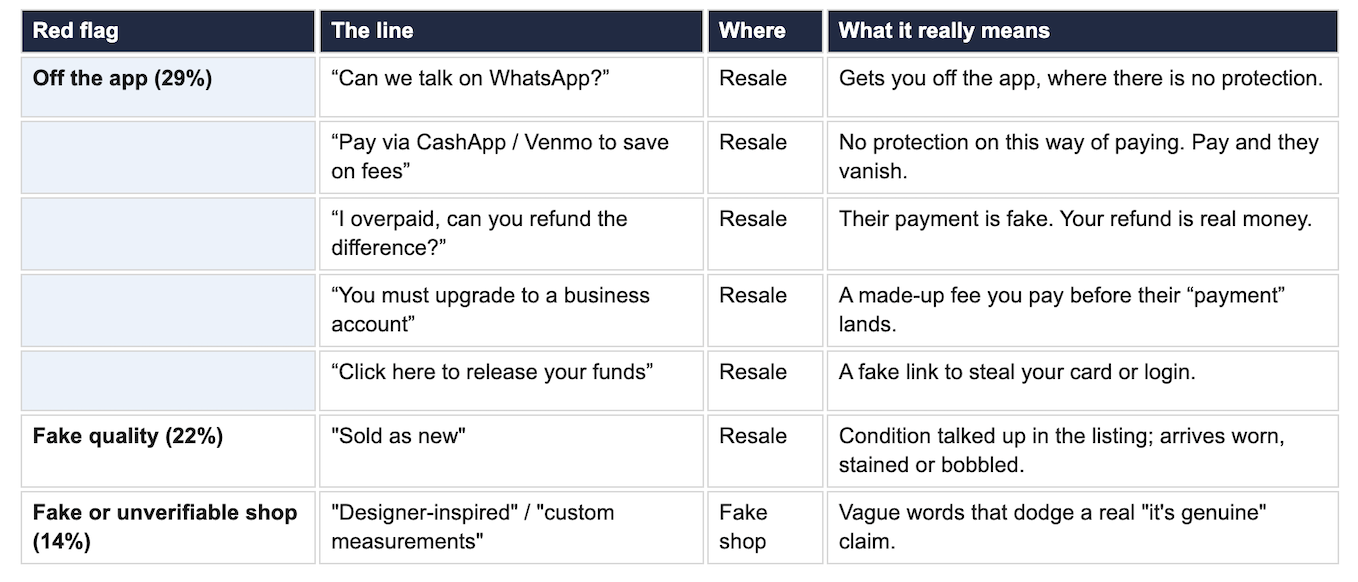
Table provided by Kaiia The Label
“The thing people get wrong is thinking a scam looks suspicious. It doesn’t. It looks like a normal person selling a nice thing at a fair price, which is exactly why it works. Almost everything we found comes down to the same fix: check who you’re dealing with, and never move the payment off the app. It’s not about being clever. It’s about slowing down enough to ask if a deal’s too good to be true.”
3. Fake shops posing as secondhand (14% of cases)
Not every "seller" is a person clearing their wardrobe. Some are fake shops built to look like the perfect secondhand, with nothing real behind them, so when you order, either nothing ships or a counterfeit turns up.
Watch for: "designer-inspired" or "custom measurements," a brand-new site, and identical five-star reviews. Before you pay, reverse-image one photo and check the shop exists elsewhere.
The full dataset breaks the phrases down by platform (Depop, Vinted, eBay, Poshmark, TikTok Shop and fake sites), adds the seller-side scams we haven't touched, and splits everything by buyer versus seller.
TRENDING

Distributed as a ‘thank you’ souvenir to business class passengers on intercontinental routes; Every October 7 –KLM’s anniversary day the collection gets a new addition. This year it’s a winery from Zeeland…